
I want to start my comments by saying that war is awful. Period. End of story. The humanitarian side of it is ugly and unfortunate. However, it has been around since humans have walked this earth, and that’s never going to change. My thoughts and prayers go out to our brave servicemen and servicewomen, along with our allies and even the innocent civilians who will ultimately be affected by the current strife in Iran.
That being said, you’ll need to get your “expert” war, political, and geopolitical opinions elsewhere (they are abundant), because I only want to talk about the potential impact on the economy and ultimately your investments and financial security.
And, very simply, the type of event taking place in Iran at the moment is unlikely to have a major impact on the “markets” for an extended period. Why? Well, there are lots of headlines hitting the wires, and quite frankly, there is a lot of uncertainty and risk that comes along with any military operation. But, ultimately, wars and conflicts typically don’t impact U.S. corporate earnings or U.S. consumer behavior significantly, which is ultimately what drives the market(s). In fact, see the chart below showing how markets have behaved 1, 3, 6, and 12 months out from a major conflict/geopolitical event. The results are fairly typical of most market environments.
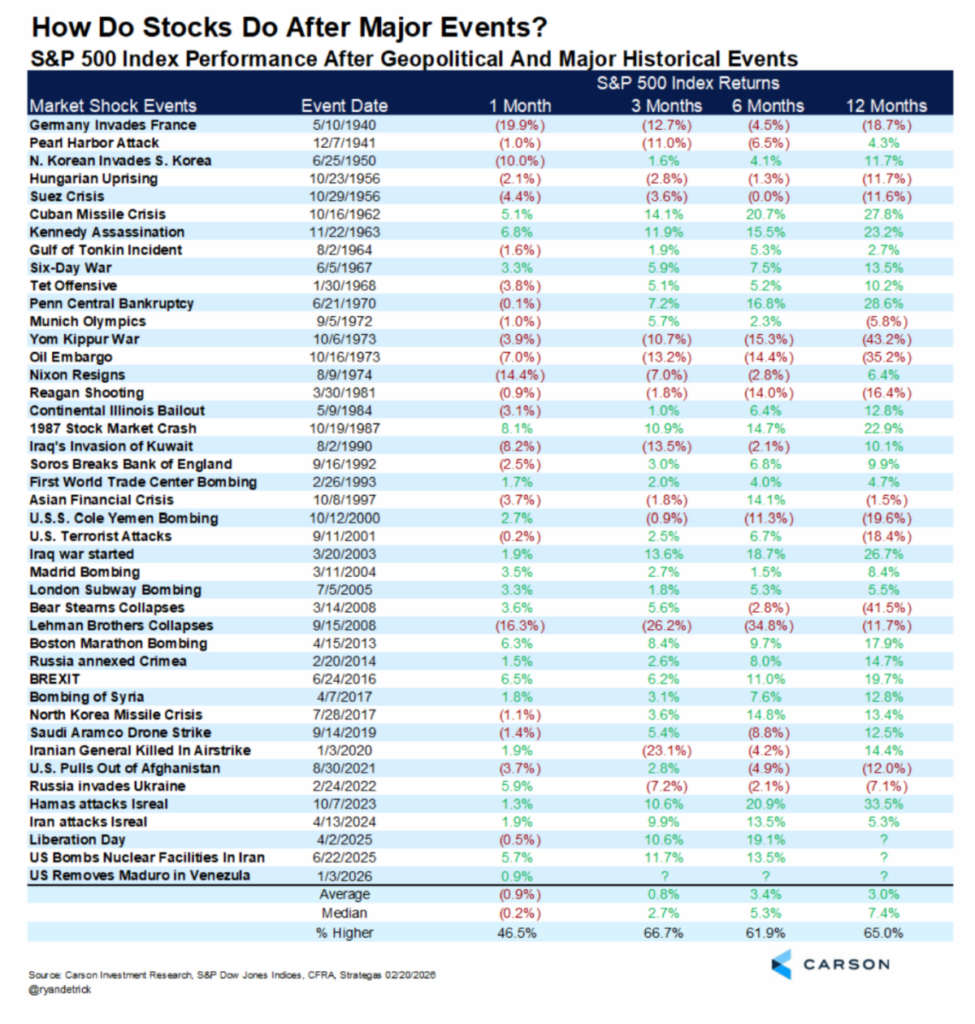
Going back to World War II, markets are higher than pre-event levels 3, 6, and 12 months out over 60% of the time. So, historically, any big volatility that comes in the early days usually represents a good buying opportunity. I expect nothing different this time.
We have to also recognize that risks have elevated. Frankly, if you read my blog you’d know that I’m not terribly optimistic about this year to begin with (https://lineawealth.com/justins-market-musings-i-what-to-expect-i-january-22-2026/), but where this could get worse than expected is IF the price of oil/gas continues to rise. High oil prices for an extended period can tip the U.S. (and other countries) into a recession. That’s a concern of mine, because Iran knows that. I expect them to continue to try to disrupt oil production and transportation to inflict financial pain on the U.S. and its allies. That being said, the U.S.A. is now a net exporter of oil (wasn’t the case 10+ years ago), so it’ll also benefit our energy industry, and our local energy companies can ramp up production to offset the supply disruptions. Ultimately, I don’t expect this to be a huge problem, but I’d be foolish to ignore the possibility. I think it’ll be another few weeks before we see how this is all going to play out.
Speaking of rocky markets, what the heck is it about February that makes bad things happen? I’ve pointed out multiple times that midterm election years are historically weak. I’ve also pointed out multiple times that February is the 2nd worst month of the year (behind September only). But why does this happen? Well, no one really knows, but I’d be remiss if I didn’t point out that the last bear market we had (2022) was a midterm election year, AND Russia invaded Ukraine in late February, which ultimately spiked the price of oil, which certainly contributed to rampant inflation and the eventual 20%+ market sell-off. Certainly sounds a little familiar to 2026 thus far…
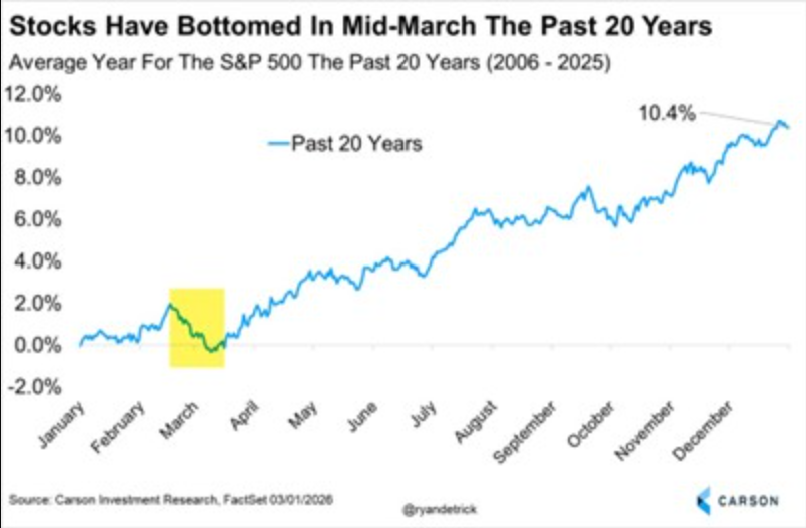
But, ultimately, I don’t think this is 2022. The economic environment is very different. Inflation may pick up a bit here, but structurally, inflation is on the way down. It was already running hot in 2022. Another reason that I’m optimistic about the coming months is that markets historically get quite weak in the back half of February through mid-March. See the chart below that shows market seasonality over the last 20 years. Late February through mid-March just isn’t good. 2026 looks to be no different here, but things tend to improve through late March and April. That’s my expectation, at least at the moment.
Thanks again to the folks at Carson Investment Research for this timely and useful information.
In summary, markets are going to be pretty volatile here. We have a global conflict that just started, right in the middle of a historically bad time of year, in a historically bad midterm election year. The probabilities suggested caution was warranted. But I firmly believe that as the uncertainty around the Iran conflict subsides in the coming weeks (hopefully), and we hit a stronger part of the year (mid-March into summer), patient investors and those who are able to allocate dry powder into their portfolio will be rewarded.
By all means, pay attention to what is going on. It is important to global national security. There will be horrific scenes and unfortunate human suffering. But, like all of the past events of this nature, we’ll move on, and markets will move higher.
Until next time….
Past performance is no guarantee of future results. For illustrative purposes only and not indicative of any actual investment. The S&P 500 Index is an unmanaged index of 500 companies used to measure large-cap U.S. stock market performance. Investors cannot invest directly in an index. Index returns do not reflect any fees, expenses, or sales charges. These returns were the result of certain market factors and events which may not be repeated in the future. The information presented is not intended to constitute an investment recommendation for, or advice to, any specific person. Tracking: 1073260-01-01